
As salespeople or managers, we all have to deal with it. Unpredictable customers and relationships. No two people are the same, so communicating can sometimes be difficult. What does your customer expect? How does he behave? How can you reassure him? And why is it that certain people always cause problems? Surprisingly enough, the explanation can be found in psychology. Did you already know Carl Gustav Jung's theory of motivation?
Customers and motivation theory and knowing customer contacts
Jung is one of the great psychologists in our history and is often mentioned in the same breath as Sigmund Freud, for example. Jung is the originator of the terms ' Introvert' and 'Extravert', terms we use to this day to categorize people. His motivation theory describes four types into which people can fall. In the image below, these types are displayed on an X and Y axis. Knowing customer contacts is essential in this regard.
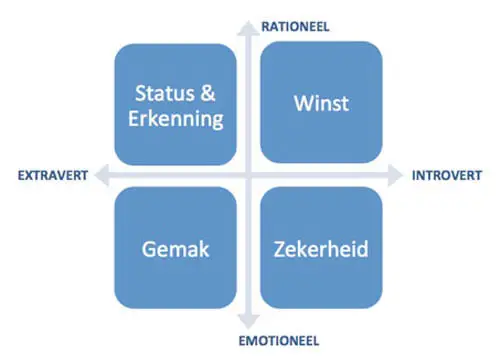
Recognition – The manager: the manager is a real entrepreneur. He makes quick and simple decisions and controls his environment. The controller can be perceived as intolerant and dominant.
Profit – The Thinker: The Thinker is analyzing. He makes decisions based on long-term and numerical analysis and is therefore very accurate and objective. However, the thinker can be fussy or indecisive. An example of a thinking could be the financial director.
Secure – The Secure: is a caring person who is focused on relationships with others. A born listener who is looking for clarity and structure. Can be passive or dependent. Civil servants often fall into this profile.
Convenience – The Creative: A creative is a very dynamic and enthusiastic person, a visionary. Can be a bit chaotic and hasty. Salespeople often fall within that profile.
Applying Jung in practice
Do you know your customer? Do you know which profile your contacts fall into? In order to properly respond to the wishes of your customers, it is very important to be able to estimate what drives the person and what their motivation is. Jung's theory can be used very well for this. Based on your customer's profile, you can plan out how they will respond to certain situations and how you can best keep them satisfied. The following lessons are important in practice:
- Is your customer a controller? Then he is mainly satisfied with facts and results. Make suggestions but let the person in question decide for themselves.
- Is your customer a thinker? Then he is particularly satisfied with extensive reports, substantiation and information based on figures.
- Is your customer a safe one? Then reassure him and indicate that everything is under control. Continuity and planning are important to this person.
- Is your customer a creative one? Then come up with solutions and confirmation to satisfy him. Make sure that enthusiasm is maintained, but above all, provide structure.
Sales training
During the Expert in Sales Basics training, you will learn, among other things, what type a lead or prospect belongs to. Through interactive simulation conversations, you gain insight into yourself and others. Learn more about psychology during one of our many sales training courses.
The importance of succession
Many sales opportunities are lost, not due to a bad conversation, but due to inadequate follow-up. After a good conversation, the customer is enthusiastic, but that enthusiasm quickly fades if there is no follow-up. Fast, personal follow-up is therefore essential. Send a summary of the conversation and the agreed next steps within 24 hours.
Make follow-up a regular part of your work routine. Schedule it in your calendar, use a CRM system to maintain an overview, and ensure you keep every appointment. Reliability in follow-up is one of the strongest signals you can send to a client. It shows that you work professionally and that the client can count on you.
Discover how our Expert in Sales Basics training can help you put these insights into practice. For over 35 years, Kenneth Smit has been helping professionals grow.
Read also
You can find more background information about knowing customer contacts at knowing customer contacts (Wikipedia).