Did you know that 95% of our behavior is driven by our unconscious? We make most decisions unconsciously, and once we have done so, we justify that decision with our conscious mind. This blog focuses on change management. There are different phases of change: which phase of change are you in?
Change management and what is behavior?
Behavior is actually everything we do. Everything we do on our own, but also everything we do in response to what happens around us. This means that behavior consists of everything we do, but also, for example, what we think. There are actually two types of behavior: conscious and unconscious behavior. We have learned a certain behavior in our lives. This largely has to do with your frame of reference; upbringing, the country where you grow up, culture, experiences, etc. This creates standard patterns that you do unconsciously. This frame of reference can also change over time.
Change is difficult
You change every day, even if you don't always realize it. When we hear the word change, many people immediately think of a major change. But for example, your hair also grows every day, why doesn't this count as a change? This is because this change is unconscious, you do not realize that your hair is growing, so you do not consider it a change. After two months your hair has grown quite long and you think: “This suits me quite well, let me keep it that way”. You have simply become accustomed to your long hair and this change in appearance has therefore occurred unconsciously.
If you turn it around, it's often a lot more difficult. How often do people say/think about changing their look. People often think about this decision for a long time and do not just impulsively change their look. This is a conscious choice. Am I really going to do my hair differently or not?
What is the idea behind this? That unconscious change is much easier than conscious change. The trick is to implement change in such a way that you don't actually notice it.
Maslow's stages of learning
In 1954, Maslow defined four phases in acquiring new knowledge, skills or competencies.
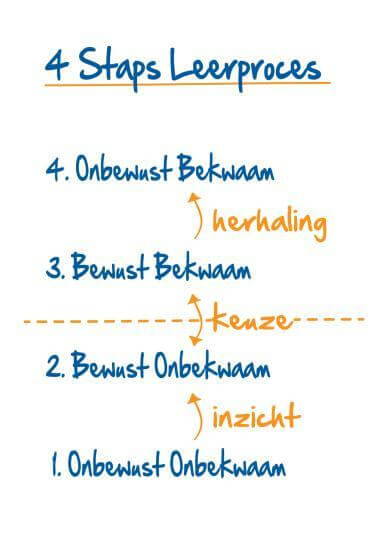
- If you don't know you can't do something, you are unconsciously incompetent. A dangerous phase, because you make mistakes without realizing it.
- When you find out you don't know or can't do a skill, you're Consciously incompetent. And if you do want to know or be able to do it, a need to learn arises.
- You learn the skill, but you still have to consciously apply it, it costs you a lot of energy and concentration. You are then consciously competent.
- As your experience and routine increases, the skill becomes easier and easier, until you almost don't have to think about it anymore. You are then unconsciously competent.
Business Improvement
Are your employees currently consciously competent? Or are they in the phase of unconsciously incompetent? Together with you, we look at where your company currently stands and where you want to go. We are happy to help you on your way with your Business Improvement #Change2Success!
Leadership begins with self-knowledge
Effective leaders know their own strengths and weaknesses. They know when to steer and when to let go. This self-knowledge does not come automatically, but requires conscious reflection and a willingness to receive feedback. Regularly ask your team how they experience your leadership and take their input seriously.
A common mistake made by leaders is thinking that they must have the answer to everything. In reality, the best leaders are those who ask the right questions, give space to the expertise of their team members, and dare to admit when they do not know something. That is not weakness, but strength.
Kenneth Smit helps professionals get the best out of themselves. Our Next Generation Management training is practical, effective, and immediately applicable.