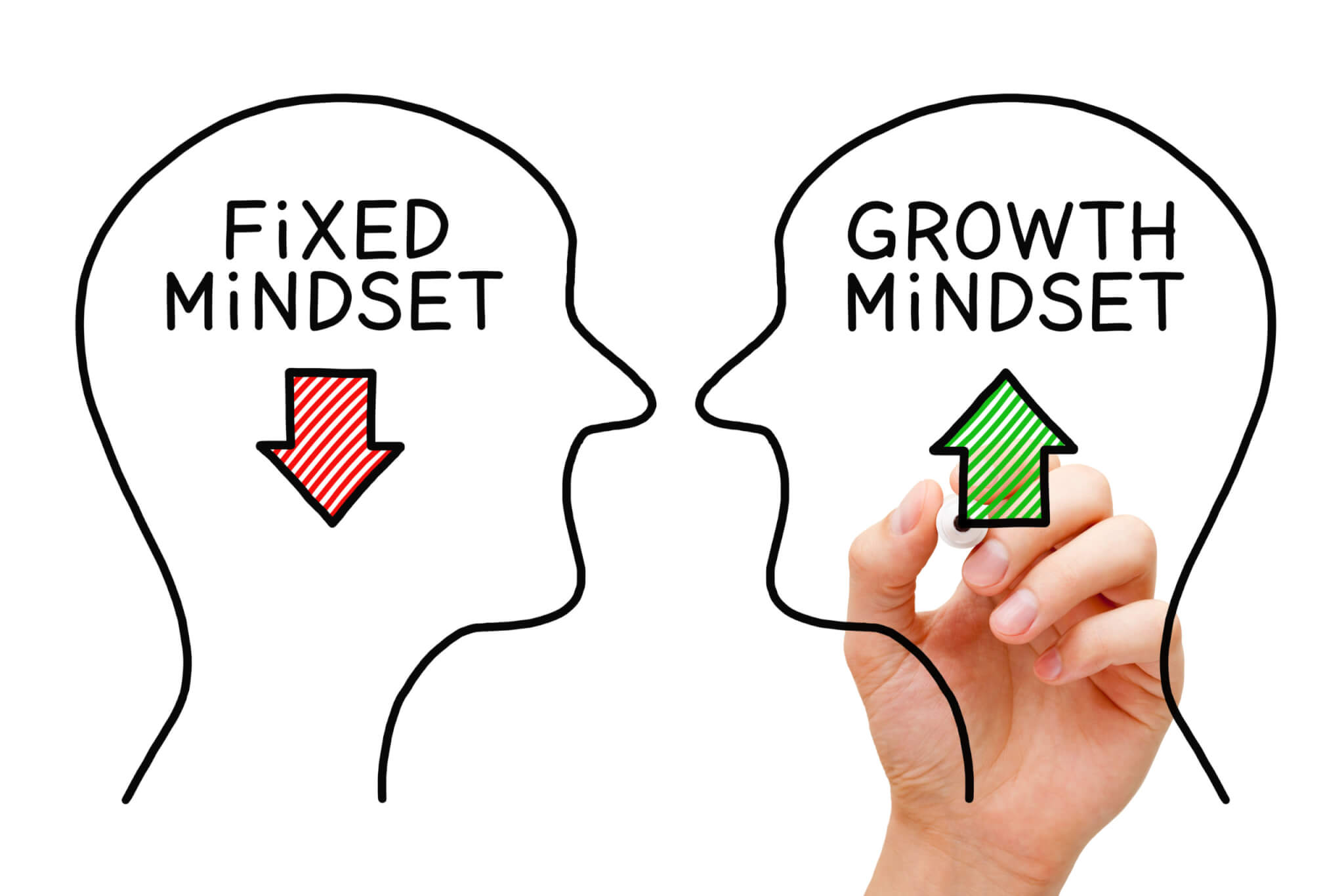
Psychologist Carol Dweck has spent her career studying attitude and performance. Her latest study shows that your attitude is a better predictor of your success than your IQ.
Dweck determined that people's basic attitudes can be divided into two categories: people with a fixed mindset or people with a growth mindset.
People with a fixed mindset think that you are just the way you are and that you cannot change. This leads to problems when you start to be challenged, because everything seems to be more than you can handle, leaving you feeling hopeless and overwhelmed.
People with a growth mindset believe that they can improve if they make an effort. They can perform better than those with a fixed mindset, even when they have a lower IQ.
This has to do with the fact that they actually enjoy challenges and see them as an opportunity to learn something new.
The deciding factor in life is how you deal with setbacks and challenges. People with a growth mindset welcome setbacks with open arms.
According to Dweck, being successful in life is all about how you deal with failure. She describes the approach to “failure” of people with a growth mindset this way;
Failure is information – we stick the label 'failure' on it, but it is more like: 'This didn't work, I'm going to solve it in a different way. I'm going to keep trying something else until it does work .'
No matter which side of the chart you fall on, you can make changes and develop a growth mindset. Below are a number of strategies that will fine-tune your mindset so that you can align it with your way of thinking and help you make growth possible.
Don't remain helpless
We all have moments when we feel helpless. The most important test is how we respond to that feeling. We can learn from it and move forward or we can let ourselves be carried away by it and end up in a negative spiral.
There are countless successful people who would never have achieved what they have achieved if they had succumbed to a sense of hopelessness: Walt Disney was fired from the Kansas City Star because he lacked imagination and no good ideas.
Oprah Winfrey was fired as a TV host because she was too emotional and too involved in the stories she presented.
Henry Ford had two failed car companies prior to his success with Ford.
Steven Spielberg was rejected multiple times by USC Cinematic Arts School. Thomas Edison has no less than 10.
She had 000 failed designs before the light bulb as we know it today came into existence. JK Rowling, when she was a single mother, had a great deal of trouble finding a publisher for her Harry Potter books.
Imagine what would have happened if one of these people had had a fixed mindset. They would have given up hope!
People with a growth mindset do not feel helpless. They know that if you want to be successful, you must be willing to fall hard, pick yourself up again, and try again.
Be passionate
People with a growth mindset have a relentless passion. There will always be someone who has more natural talent than you, but what you lack in talent you can more than make up for with your passion. Passion is what drives them.
According to Warren Buffet, you can discover your true passion using what he calls the 5/25 technique: Write down 25 things you care about most. Then cross out the last 20. The other five are your true passions. Everything else is just a distraction.
Take action
It is not that people with a growth mindset are able to overcome their fears because they are braver than the rest of us. It is simply because they know that fear and worry are paralyzing emotions and the best way to overcome them is to take action.
People with a growth mindset are confident, and confident people know that there is no such thing as a truly perfect time to take action.
So why wait for such a moment? Taking immediate action transforms all your worries and anxiety about failure into positive and focused energy.
Take that extra step (or two)
People with a growth mindset always give their all, even on their worst days. They are always striving to take that extra step.
If you always set limits on what you can do, physically or otherwise, that will be your attitude for the rest of your life. It influences you in your work, in your morale, in your whole person, and in your entire life!
There are no limits. There are steps, but you shouldn't stay there. You must go further than the step you are currently on. A person must constantly strive to reach that other level.
If you don't get a little better every day, chances are things are going to get worse and what kind of life is that?
Expected result
People with a growth mindset know that sometimes things go wrong and can therefore fail, but they never lose sight of the result that needs to be achieved. Setting goals and measuring results keeps you motivated and strengthens self-confidence.
And tell me, if you already think it's not going to work, why would you do it?
To be flexible
Everyone faces unexpected setbacks. Take, for example, the COVID crisis in which we have now found ourselves for almost a year. People with a growth-oriented mindset embrace adversity as a means for improvement or change, rather than as something that holds them back.
When an unexpected situation arises, they bend over backwards until they achieve the desired results. Over the past few months, numerous creative new initiatives have emerged from entrepreneurs and people with a growth mindset.
Don't complain when things don't go your way
Complaining is a clear sign of a fixed mindset. A growth mindset looks for opportunity everywhere, in everything, so there is no room for complaining.
Bringing it all together
By keeping track of how you respond to different situations, you can work every day to keep yourself on the right side of the image above.
Success!
Hylke ter Beest
Source: Emotional Intelligence 2.0 by Dr.Travis Bradberry