

Read here Thoughts - Tips - Including 5 aspects of successful teams
INTRODUCTION: Staying Behind or Boarding
It is an uncertain time. Panic is spreading left and right. By now, you probably start gagging at the mere mention of the word 'Corona'. While some are pulling out all the stops to limit the damage, business has come to a complete standstill for others.
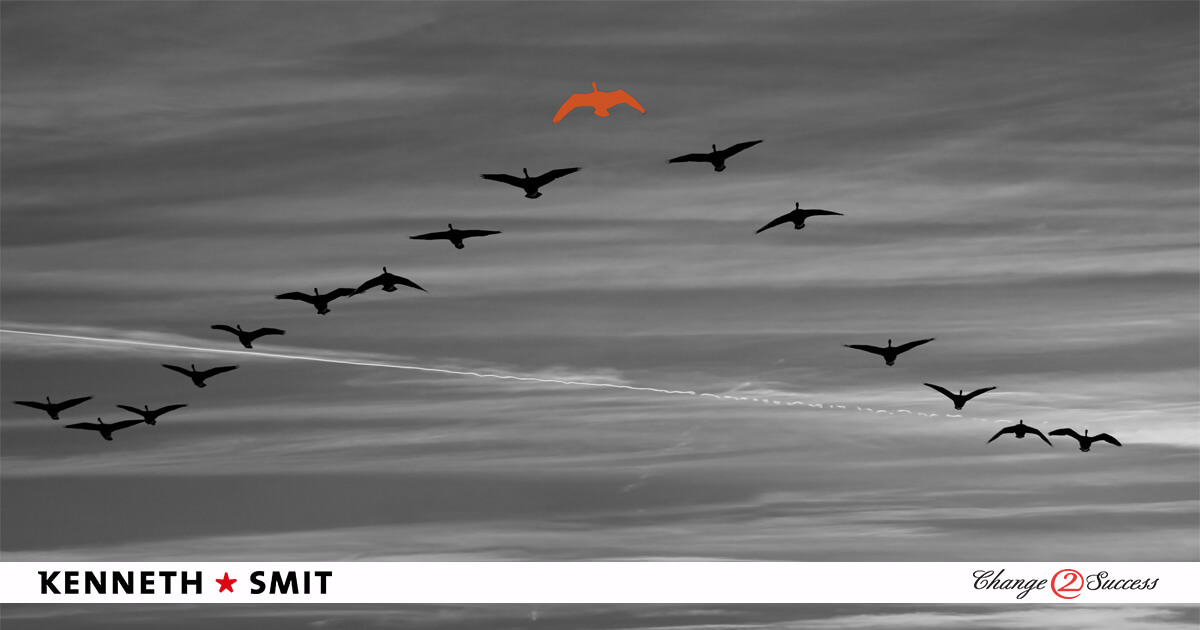
This, while there are also companies with top revenues. In this blog of approximately 1950 words (about 7 minutes reading time), you will find 'Food for Thought – Tips – and 5 Aspects of Successful Teams'. Because after 'Corona', it becomes a matter of Lagging Behind or Getting On Board; you and your team decide 'How' you are going to achieve this.
THE REALITY: In addition to running, especially NOW also take a moment to stand still
It is a period of 'Human Effort' in its purest form. No matter how you look at it, everyone needs luck, but luck alone won't get you there. Fortunately, much is achievable; according to some American gurus, 'EVERYTHING' is achievable.
However, research shows that approximately 50% is determined by your background, your OMA is a major factor in this (OMA is an abbreviation for Beliefs, Opinions, Assumptions), 10% by circumstances (well, I already wrote: we all need luck).
This leaves approximately 40% that is feasible and with which we can make a difference.
NOW is the time to reflect on this, to zoom in. Because no matter how dark the clouds are, different times will come, most likely preceded by an Economic Crisis.
Many people are currently required to work from home. I frequently hear and read in the media that this is going to be the breakthrough for remote working. That is fine, but I would still like to add something to that.
Working from home seems nice, but it isn't for everyone. While some do their work comfortably and relaxed at home, others get an uncomfortable and lonely feeling from it.
I once had an applicant for our field sales team covering the Northern Netherlands region. We had an excellent candidate.
When he heard that our office was in Groenlo (he lived in Groningen, conveniently central in his territory), an unexpected hitch occurred. He absolutely insisted on coming to the office every day to consult with colleagues before heading out.
He enjoyed being on the road, but couldn't stand working from home four days a week. He found that one day at the office for coordination far too little. We came to the conclusion together that it wasn't going to work.
Currently people have no choice, they have to work from home.
Perhaps you were already used to working from home; does this apply to your colleagues as well? Therefore, please pay extra close attention to your people these days. Every person is different, and everyone has a different perspective. Give those who need some extra attention this one-on-one attention and consciously make time for it.
Skype, Teams, and Zoom (I have also taken out a subscription now) are great options for FaceTiming. I believe the goodwill you build with them will pay off later. Whether this is internal or external doesn't matter for now.
Back to my story. We are busy cleaning up the SOY (Shit Off Yesterday) and getting the work on track today.
Currently, I speak with clients every day to catch up, hear what challenges they are facing, or take a moment to brainstorm together. There is one certainty at this moment, and that is that we are all facing uncertain times.
Do you also offer a listening ear and proactively give 'quality time' to relationships? Find out what you can help with, because together we are strong. I hope with this blog to encourage people to take more targeted action together.
THE ADDITIONAL CHALLENGE: How do you deal with uncertainties?
What I hear is that 'in addition to performing today' there is an additional challenge; How do we ensure that we are always ready as a team to take on the challenge of a situation in times like these that feels like juggling because the experience is lacking.
What I would like to draw your attention to is making time and focusing your vision on the future, despite all the current uncertainties. This will feel very unfamiliar to many (after all, we are primarily 'doers'), but you are laying the foundation for the future.
Tip: Spend at least 25% of your current workday on this to create a 'forward-looking memory', so to speak, and then take action on it.
Have you ever noticed that a 2000 piece puzzle is easier, faster and more fun to do with a picture of the final result in your hands?
Standing still was never an option, but now it certainly isn't anymore, should you still have any doubts. We live 'on' a world that is flat again; in fact, we live in a large village, and everything that is not meaningful is going to disappear. Natural selection?
How do you deal with this as a team? To know more, read on;
YOUR OWN SQUARE METER: compared to that of colleagues
People like to focus on their own roles. Roles such as Account Manager, CFO, CPO, Product Manager, or Logistics Manager (and we could go on).
This is good because the focus is on the work and this provides stability and certainty when defining tasks and responsibilities, so that you can switch quickly.
That is why you can be particularly productive at home. Although, unfortunately, that can also be a pitfall.
'Working with focus' and 'depth' in the job has led to more and more specialist positions. This way we get the most out of it, get into a flow faster and achieve better results. But then on that proverbial 'own square meter' and that is where the danger immediately lies.
I hope that many specialists work at your company who are driven, enthusiastic, and passionate about helping clients move forward. I hope even more that they go through life with an open mind and collaborate closely with colleagues.
Moreover, everyone has their own specific tasks to deal with, meaning that subconsciously or unconsciously slightly different interests may come into play, even though everyone sincerely has the best intentions.
t. the company. Failing to recognize and acknowledge these different interests makes the difference between 'oil or sand' in the gears.
It is a bit like the difference between the left and the right Twix in the TV commercial. Differing 'self-interests' can lead to significant mutual annoyance. It requires coordination, give and take, and knowing each other's strengths and weaknesses.
A good team has, as it were, a single heartbeat. How good is your team, and do you have “employees,” “co-workers,” “collaborators,” “co-workers,” or a mix? I sincerely wish you many “co-workers.”
THE DEPTH: Which aspects play an important role within teams?
1) What is the importance of a good team?
2) What makes successful companies pay attention to this?
3) Which 5 aspects play an important role within teams?
Ad1) What is the importance of a good team?
The world is changing at a rapid pace.
-A life without a smartphone is no longer conceivable and with the arrival of 5G it will soon be even faster, so make sure you are ready.
-More than 30% of all knowledge held by every recent graduate is totally irrelevant and outdated within 3 years. (Source: MT October 24, 2019 | How much is a recent graduate's transcript really worth) Note: When did you graduate?
And your “collaborators”? How do you learn from and with each other?
-There is currently a high demand for, among others, data specialists and people who develop the software that will ensure they themselves become redundant in 5 to 10 years.
After all, the artificial intelligence can then simply perform it better, smarter, and faster on its own. Back to your company: Can everyone within the company handle the many changes that are coming? Waiting until people collapse is not an option.
In short, for many people, these times are not fun. They may laugh, but they are not having a good time; they experience stress, anxiety, and burnout symptoms. They would prefer peace and quiet, but realize that it will never return.
Therefore, you need a team that takes care of each other like a 'FAMILY', but also of progress. There is nothing 'soft' about that. Self-determination theory states that humans have three innate basic psychological needs.
These basic needs are autonomy, connectedness, and competence. By working on these together, everyone comes into their own. A pleasant side effect: within a successful team, there is less turnover, and moreover, it attracts other people who are eager to contribute.
This, in turn, widens your lead over other employers in the battle to attract mega-talents. Furthermore, it gives your team(s) the opportunity to develop further.
Ad2) What makes successful companies pay attention to this?
Due to rapid changes, people will have to be continuously proactive about their work, training and further education. If not, the question is: When do you get out?
It has been known for over 25 years, thanks in part to Daniel Goldman of “Emotional Intelligence”, that it is not the people with the highest IQ who are successful, but rather those who know how to combine IQ with a good EQ. I would like to add something to that: having the 'struggle factor'.
Persevere to achieve success, but SMART.
In my view, EQ and the 'struggle factor' are becoming increasingly important, and within that, how you collaborate as a team. The right team makes the difference between good and excellent. Every company is only as successful as the people who work there and the performance they deliver.
Ad 3) Which 5 aspects play an important role within teams?
-A clear Vision, Mission, and Strategy from the board (not having these causes 'confusion'). This should lead to a clear plan from the team (unless you want chaos, in which case you definitely shouldn't have this clarified).
How clear are your Vision, Mission, and Strategy? And to what extent do your 'collaborators' endorse them?
-Having good knowledge of yourself and the other team members is key. Empathy and mutual understanding play an important role in this.
Every person has their own perception or image of reality, and this can lead to a great deal of confusion. Therefore, ensure that problems within the group NEVER become old.
-Self-confidence as a team member and confidence in mutual cooperation makes the sum of the parts greater. Just look at the well-known time trials in cycling rounds because people inspire, stimulate and challenge each other. What do you contribute to strengthening the self-confidence of your people?
-Flexible yet decisive. If not counterclockwise, then rightward or perhaps straight through, but together, because tomorrow can look completely different and we will also have to make that day a success together. This requires a resilient team.
-The desire to continuously improve, to set the bar high, to always keep the goal in mind and to keep each other connected, without this leading to aggression, overconfidence or burnout. In addition to great mutual trust, this also requires courage.
In the future it will increasingly be about making choices. An open door? It will be Stay Behind or Get In. Have a discussion about it with your team!! Find out what they think and, above all, that 'seemingly small improvements' can lead to big results.
FINALLY:
Did this blog make you think?
Please share it with colleagues, MT, DT, your business network, your LinkedIn downline. My goal is to help as many entrepreneurs, enterprising salespeople, enterprising managers and their teams emerge from this time successfully.
Koos Minnema
[email protected]
06 - 51965959