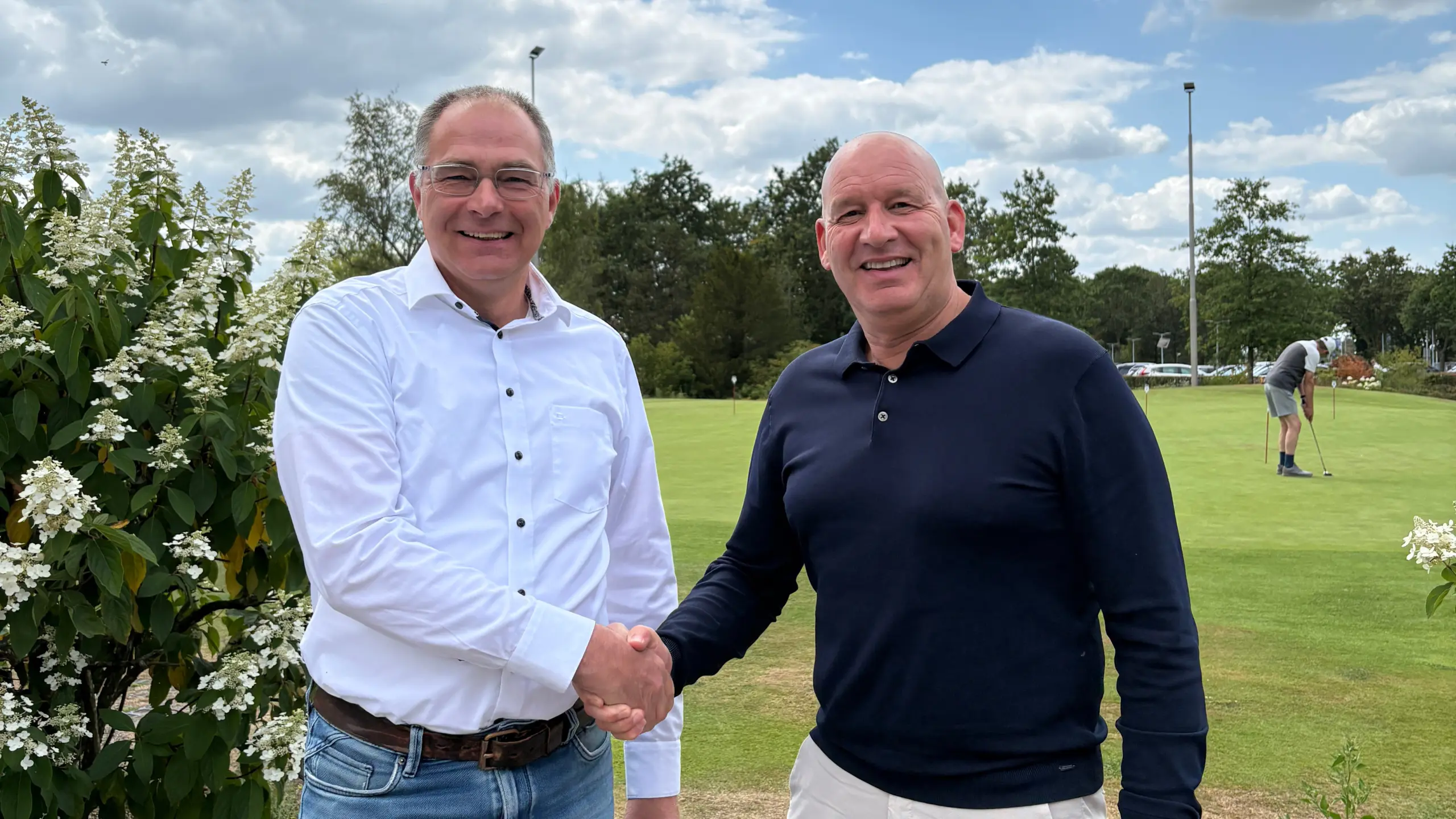
Koen van Gorp has been a trainer at Kenneth Smit for twenty years. During that time, he built lasting relationships, including one with Victor Coppens, Industrial Key Account Manager & OE Commercial Leader at Flowserve. What began as a commercial issue grew into a collaboration that has now endured for more than two decades. While the initial programs focused on sales skills, communication, leadership, and management were added over the years. Consequently, the focus shifted from a single training request to a broader investment in the development of people within Flowserve.
What enables such a collaboration to continue growing after more than twenty years? For Koen van Gorp and Victor Coppens, the answer lies in the way development is continually linked to daily practice. In conversation, they look back on the start of the collaboration, the changes within Flowserve, and the role training played in the development and growth of employees, teams, and managers.
Why Flowserve invested in commercial skills
There is a difference between knowing what you offer and understanding what a customer truly needs. At Flowserve, where sales engineers know their pumps and seals in detail, that insight prompted them to start training with Kenneth Smit.
“Our people know exactly which products we have and what they can all do,” says Victor Coppens. “But you can talk and argue about that endlessly. The question is whether that is what a customer wants to hear.”
The next step therefore lay in the shift from product-oriented to customer-oriented selling: strengthening commercial skills, conversational techniques, and customer-oriented behavior, so that an individual can develop from a product specialist into a reliable and professional conversational partner at all levels.
Koen van Gorp sees this issue frequently at technical companies. “Salespeople usually spend the most time on the area where they are least unique,” he says. “That is often a real eye-opener during initial practical situations.” In his view, the difference emerges much earlier in the relationship: in making a genuine connection, winning trust, and the ability to determine what a customer actually needs. Or, as he puts it himself: “people do business with people, not with products or organizations.”
The conditions for development
Sustainable behavioral change only occurs when a number of conditions come together. Intrinsic motivation forms the basis for this, a safe learning environment provides room to practice, and committed managers who coach on this help to sustain new behavior in practice.
People can only change themselves.
Why does one participant show visible growth, while hardly anything changes for another, even though they are taking the same training? Koen explains this difference in terms of intrinsic motivation, talent, and the willingness to want to get better every day.
According to Koen, training does not fundamentally change anyone; it makes motivated people a step better. A trainer can motivate, provide feedback, confront, and offer new skills, but the decision to put them into practice ultimately rests with the participant themselves. According to Koen, change only occurs in people who see the benefit and necessity of it themselves. “Our profession is sometimes about breaking old behavioral patterns in a safe learning environment and replacing them with more effective skills,” he says.
Victor recognizes this from experience. “You can offer opportunities, organize training, and provide guidance, but ultimately, the motivation has to come from within,” he says. “If someone comes in thinking, ‘Here’s another one of those training sessions,’ then it’s going to be a long day.”
In this regard, Victor sees a fundamental difference between mandatory development and development that aligns with personal ambition. He views the latter as the driving force behind sustained growth. When someone wants to improve in their profession, take on more responsibility, or is curious about their own capabilities, space for change opens up. Training then becomes a tool to advance, not a mandatory part of the job.
Learning requires a safe environment
According to Koen, development begins with safety. Participants receive valuable feedback on their daily behavior and skills, practice new skills, and are confronted with habits that have been taken for granted for years. This requires courage and an environment where people dare to be vulnerable.
“If you do that in a safe setting, where it’s not about failure or success, you bring out the best in people,” says Koen.
It is precisely in such an environment that space is created for an important first step: awareness. According to Koen, development rarely begins with a success experience. Much more often, it starts with the realization that something can be done differently or even better. Koen describes this as the step from unconsciously incompetent to consciously incompetent. An insight that sometimes feels uncomfortable, but forms the basis for further growth and change.
Victor still remembers well how that felt during his first training sessions. The camera, the feedback, and the exercises made visible behavior that normally remains hidden. “Conversations that you think are going fine sometimes turn out to come across very differently. You discover that you make assumptions, become defensive when faced with resistance, jump to a solution too quickly, or talk more than you listen.”
Moments like that can be confronting, but according to Koen, that is precisely where the start of awareness, change, and improvement lies. As he puts it himself: “Because if you always do what you’ve always done, you will never get more than you’ve always gotten!”
Engaged managers enhance learning efficiency
An important part of Flowserve's approach is that managers participate in training themselves whenever possible, rather than being involved only remotely. According to Victor Coppens and Koen van Gorp, this makes a significant difference. A manager who is part of the group experiences firsthand the challenges, insights, and areas for development involved, in addition to what employees learn.
During the years he managed commercial teams, Victor consciously chose to participate in the training himself. He never saw himself as someone who stood above the group. Precisely as a manager, he wanted to understand what employees were experiencing, hear what was going on, and be part of the learning process himself in order to learn and coach optimally.
“The moment you become a manager, suddenly a lot of things stop being said,” he explains. By actively participating, he narrowed that distance and remained connected to what was going on within his team. According to Victor, this also yields valuable insights. “Then you see: who are the talents within the group? Who picks things up well? And who might be struggling more? You take that into account in the further development and coaching of your team.”
According to Koen, that involvement also has a clear influence on the group. As soon as managers actively participate, the dynamic in the training room changes. “When you are there, you are not a spectator; you simply participate as a participant,” he says. “You make yourself vulnerable and you also appear on camera.” Managers receive the same feedback, perform the same exercises, and experience the same learning moments as their employees.
This creates a shared experience and a common language within the team. Feedback gains more value, conversations become more open, and the training feels less like an evaluation of employees. For Victor, there is also a principle behind this: whoever asks others to develop themselves and be vulnerable must be willing to do the same. According to him, it is precisely this that increases a manager's credibility and ultimately strengthens the learning efficiency of the entire group.
Development that moves with the organization
Insight alone does not change behavior. Lasting behavioral change only occurs when people continue to apply, practice, and refine what they have learned. The challenge lies in translating new insights into daily practice. Therefore, the training courses at Flowserve are structured as an ongoing development trajectory, featuring up-to-date theory and practical simulations, in which the course content continuously evolves with the participants' level.
Ongoing development tracks
“We don’t do one-off training sessions,” says Koen. “I usually don’t believe in those.” According to him, training can make people aware of their behavior, but lasting behavioral change requires time, practice, and the power of repetition. “I don’t believe that a one-off training session turns a two into an eight. I do believe that a six becomes a seven, and a seven an eight or nine.” In that respect, training is just like top-level sports: having the will every day to be better than yesterday.
Based on this conviction, the collaboration with Flowserve grew into a long-term development trajectory. Each phase builds upon the previous one, allowing the content to evolve along with the participants' level. As they gain more experience, the emphasis shifts from theory to application. Therefore, the refresher training consists almost entirely of practical simulations involving situations taken directly from their own daily practice.
To keep participants focused, Koen works towards a final test. “A final test is important for people. We continuously maintain that awareness on the way to a well-deserved diploma.”
By now, the development program has become an integral part of the organization. New employees join almost automatically. According to Victor, the request often comes from them themselves. They hear experienced colleagues talking about communication techniques, working methods, and insights from the training sessions and want to put them into practice as well. Koen sees that as the greatest compliment. “It shows that the training yields more than just individual development: it fosters a collaborative way of working and a shared perspective on customer contact.”
The power of recognizable case studies
According to Victor, customization is one of the greatest strengths of the training courses. The content aligns so closely with Flowserve's practices that participants regularly wonder how Koen knows it all. Extensive preparation lies behind every session. Conversations with managers, developments within teams, experiences from previous programs, and current organizational challenges form the basis for new case studies and exercises.
This preparation explains why participants immediately recognize themselves in the situations they work with. The topics resemble conversations they recently had with clients, ongoing negotiations, or dilemmas teams deal with on a daily basis. As a result, the training feels less like a separate learning environment and more like an extension of practice.
Victor sees how that process unfolds throughout the year. “In the training sessions, the case studies are very realistic, and they address the challenges we encounter on a daily basis,” he says. “Managers point out what teams are struggling with, but Koen also hears what is going on in the workplace during coffee breaks and lunches. He listens constantly and picks up on those things.” It is precisely because of this that the training sessions remain relevant and aligned with what is happening within Flowserve.
Furthermore, the strength of the training lies in the knowledge Koen has built up during twenty years of collaboration. He knows the organization, the people, the developments, and the challenges associated with them. Twenty years of continuity thus led to depth rather than repetition. The organization changed, and the training changed with it. What remained is the conviction that development only has value when it stays connected to the daily practice of the people participating.
The result of twenty years of investing in development
What has twenty years of training at Flowserve concretely yielded? For Victor, the answer lies in people: in how they behave, how they grow, and how long they stay.
Growth that becomes visible in behavior
When Victor is asked what the training sessions ultimately yielded, he immediately points to the development he sees in the participants. “You really see that people grow as soon as they have mastered the material. They radiate more confidence and calmness.”
According to Victor, this also changes the way they conduct customer conversations. “Where they used to clam up at a customer’s objections, now they think: ‘Bring it on.’ Then you go looking together for what the customer really needs, instead of getting stuck on what he doesn’t want.”
He also sees that change reflected in the results. Salespeople regularly return after a training session with an order closed without a discount. “Anyone can give a discount,” says Victor. “That is the easiest thing there is.” For Koen, that is precisely the turning point a training session should bring about: only when price becomes the last instrument instead of the first has something actually changed.
However, according to Victor, the return on twenty years of training cannot easily be captured in hard figures. “Can you say: if we hadn't had that training, we wouldn't have had that order? That is difficult. But I do know that we have had a great many orders at better prices and our customer relationships have become more sustainable.”
Growth as indirect evidence
Victor sees a second form of impact in the careers of employees. During the conversation, he mentions several colleagues who once participated in commercial training and now hold leadership positions or are responsible for larger parts of the organization.
However, Victor and Koen emphasize that development does not necessarily mean moving up the ladder. Sometimes, the greatest gain lies precisely in discovering where one's strengths lie. Koen tells the story of a successful salesperson who realized during management training that managing gave him little energy. Instead of holding on to a management role, he chose to return to sales. "He is going to excel again in what makes him happy," says Koen.
Victor also views this as a result of training. Training can help people consciously choose a role that suits them better, even if that does not entail advancement to a next position. “Development begins with valuing people and looking at where their talents lie. From there, you can discover together how someone can develop further and what makes them happy.” According to him, it is precisely this choice that contributes to sustainable growth, both for the employee and the organization.
Development that binds people
Perhaps the most personal part of the conversation emerges when Victor talks about the people who are still there. While many organizations are dealing with turnover, he looks with visible pleasure at colleagues who have remained part of Flowserve for years. “The best thing you can achieve in all those years is that people stay with your organization, feel appreciated, and continue to develop.”
According to Victor, that is inextricably linked to the attention the organization pays to development. Employees feel that they are being invested in, are given opportunities to develop new skills, and can advance to other responsibilities. For Victor, that is ultimately the most important outcome of all the training. “What I am most proud of is seeing my team grow. The ultimate achievement is the promotions of people on my team. And perhaps even better: that they are all still here.”
Why the collaboration continues
When the conversation finally returns to the collaboration between Flowserve and Koen, it feels like the logical conclusion to everything discussed earlier. According to Victor, the strength lies in the way the training sessions have consistently remained aligned with daily practice. The content evolves with the organization, the issues are relatable, and the approach aligns with the reality of the moment. As a result, the training sessions are an integral part of how Flowserve invests in people development.
Koen views the same collaboration from a different perspective. For him, a sustainable partnership begins with the underlying relationship. “My core values are respect, appreciation, trust, and reciprocity.” He recognized precisely these values at Flowserve right from the start. According to him, they form the basis for open conversations, honest feedback, and the ability to challenge each other when necessary.
The way in which the collaboration is being handed over also demonstrates how firmly it is anchored within Flowserve. Victor is gradually transferring contact with Koen to his successor. For Victor and Koen, this is perhaps the strongest proof of the past twenty years: the collaboration has grown into something greater than the relationship between two people. It has become part of the way Flowserve views development.