
Personal development. It is hidden deep within our character as human beings. In 1943, Abraham Maslow published his theory of motivation, which describes what drives people.
His hierarchy of needs is used to this day. The desire to develop ourselves is innate and deeply embedded in our DNA.
This is also evident from the large number of studies conducted in this area. And yet, within our companies, we often fail to work effectively on personal development. Why not? And what can we do about it? We discuss this in our blog today.
From Maslow to reality
You may already be familiar with Maslow's motivation theory. It describes our innate needs as humans, both private and business.
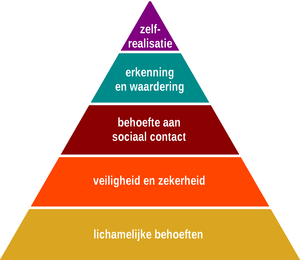
- Physical facets, such as sleep, eating, drinking, but also sex and exercise.
- Safety and security, which we find within small or large groups. Examples are housing, work and relationships.
- Social contact: the need for friendships, love and positive social interactions.
- Appreciation and recognition from others in your environment, to strengthen self-confidence.
- Self-realization. Personal growth. Personal development!
Research by Cubiks, conducted in 33 countries, shows that employees consider the opportunity to develop themselves even more important than a salary increase or extra vacation days. An unexpected outcome?
Not if you consult Maslow's pyramid. When employees were asked which facet of personal development is considered most important, over 45% indicated that deepening knowledge ranks number 1.
This was followed by improving competencies, at 28%. So, we prefer to dive into the content, which feels somewhat safer, rather than making ourselves vulnerable and working on personal areas for improvement.
'Only' 27% of employees indicate a career move as the main motivation for personal development.
Groupon is also contributing. Research by the deals site, conducted among more than 1.000 Dutch people, showed that no less than 90% of the Dutch describe personal development as very important.
Young people in particular are very focused on their development, as evidenced by the 100% score within this age group. Striking fact: young people consider personal development even more important than their appearance.
And yet it often doesn't work
Despite the fact that it has been clearly demonstrated that personal development is at our core and is an important part of our lives, we often fail to deal with personal development effectively.
For example, the same Groupon survey we just referred to shows that for 42% of respondents, money is a factor in reducing their personal development efforts.
Lack of time comes second at 40%.
We therefore feel that we have too little time to develop ourselves optimally, or find the investments required to do so too high. In our view, however, there is another very important reason why we often fail in effective personal development: self-knowledge!
We rarely conduct a thorough personality assessment, even though it forms the basis for developing your own personality.
Get to know yourself
The Chinese warlord Sun Tzu said it: 'know yourself and your opponent, then you will win every battle'. Knowing yourself is a rare but extremely important facet of personal development.
You can take various steps to get to know yourself or your employees. A commonly used step is creating a personality profile. At Kenneth Smit, for example, we use the Insights Discovery learning system and profile.
Insights Discovery is an accessible color model that provides insight into yourself and others. A strong foundation for your personality profile and a starting point for functioning optimally.
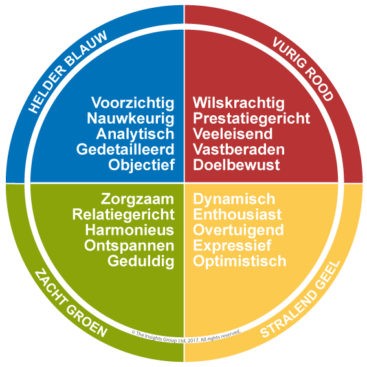
Insights Discovery works with four basic colors that describe your personality type:
- Fiery red: willpower, achievement-oriented, demanding, determined, purposeful
- Radiant yellow: dynamic, enthusiastic, convincing, expressive, optimistic
- Soft green: caring, relationship-oriented, harmonious, relaxed, patient
- Bright blue: careful, precise, analytical, detailed, objective
Every person has all four colors within them. However, it is the combination of colors that characterizes your unique personality. The colors refer to behavioral preferences and determine how a person reacts, thinks and acts.
Based on the color model, eight primary insight types can then be distinguished, to which strengths and pitfalls can be linked at a later stage, as well as the ideal role that you can fulfill within an organization.
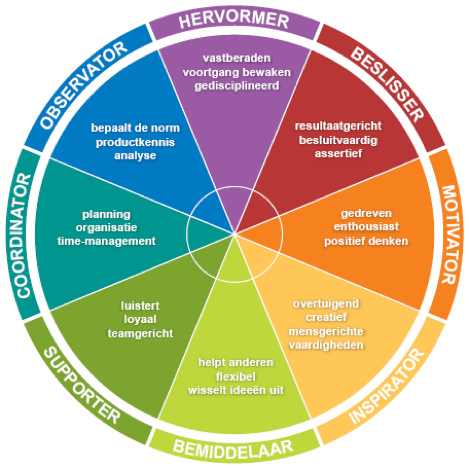
- Reformer: determined person who monitors progress and works in a disciplined manner.
- Decision maker: results-oriented person who is decisive and assertive.
- Motivator: driven and enthusiastic person who often thinks positively.
- Inspirer: convincing and creative person with many people-oriented skills.
- Mediator: likes to help others, is flexible and exchanges ideas.
- Supporter: team-oriented person who listens well and is loyal.
- Coordinator: systematic and organized person with good time management skills.
- Observer: person who sets the standard, has a lot of product knowledge and is highly analytical.
Our advice: start the personal development process within your organization, which starts with examining the personalities within your team, so that an effective development plan can be drawn up for each person based on their personality profile.