
Something is brewing within your company. You have the feeling that the prevailing culture no longer fits the future vision of the organization. So it's time for a refresher of the corporate culture. But that's easier said than done. The timing may not be perfect, or you expect a lot of resistance. Virtually no factor of management is as elusive as corporate culture. Let alone changing that. How do you deal with that? Do you need to change the corporate culture within your organization? In this blog we try to help you get started.
Must and what kind of culture does your company have?
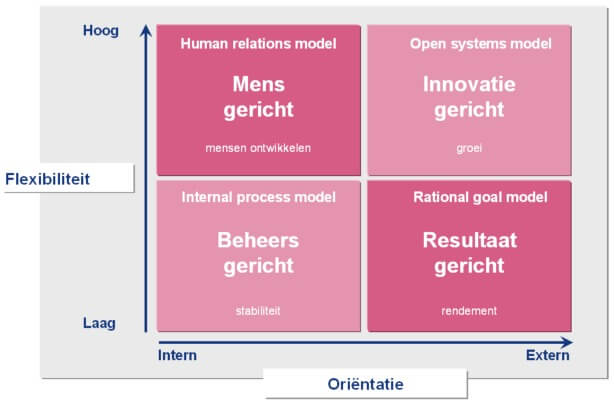
To determine whether your corporate culture could use a refresh, it is important first and foremost to thoroughly analyze what the culture actually is. What are your organization's core values? Core values are important for the organization's identity; they provide employees with a sense of stability. Attitudes and behavior are determined by them. Corporate culture is an intangible and abstract concept. It is sometimes difficult to grasp. The Competing Values Framework by Quinn and Rohrbaugh from 1983 is a useful model to use when analyzing the prevailing corporate culture within your organization.
People-oriented
A culture that is strongly focused on the human factor. Human relations are paramount, and the culture is mainly focused on developing employees. Training, evaluation, shared objectives and collaboration are important concepts. The people-oriented culture has a high degree of flexibility and internal orientation.
Innovation-oriented
Many technology companies have an innovative culture. Strongly focused on working with open systems, such as open source, and based on growth. This culture is very flexible and much more externally oriented than the people-oriented culture.
Results driven
A culture that you often encounter in highly commercial companies. Strongly focused on rationality and returns. A very high external orientation with low flexibility.
Management-oriented
A culture based on internal processes. Financial institutions often have such a culture. The culture is strongly focused on controlling processes and quality, so that few mistakes are made. Low flexibility and very internally oriented.
Change corporate culture?
A corporate culture is very difficult to change. The risk of failure is high. The culture partly determines the type of people who are attracted to your company and the results. If you have a management-oriented culture, many of the employees who will work for you will have the same character traits. Introducing them to an innovative culture will be counterproductive.
If you are of the opinion that the corporate culture should contain other nuances, then at least take the following tips into account:
Actions rather than words
You can take a long time to put a great culture strategy on paper together with all stakeholders. Of course there has to be a plan, but don't make it too complicated. Ultimately, you can only really test whether a cultural change is realistic when you actually start working in practice. Learning by doing certainly applies to cultural change.
Explain your story, reinforce it with images
Corporate culture is intangible, we had already concluded that. Culture can also be a difficult concept to grasp through the eyes of your employees. So it is important to explain what your story is. You have to give meaning to the cultural process. This can be done, for example, by using images, with which you can make things tangible. For example, many organizations use personas to clarify a change process for everyone involved.
Celebrate your success stories
Change is never fun, especially when it comes to culture. People are often pessimistic about it, and you need to break through that. So focus on the success stories, no matter how small. Ensure that the culture process evokes positive feelings in people instead of pessimism.