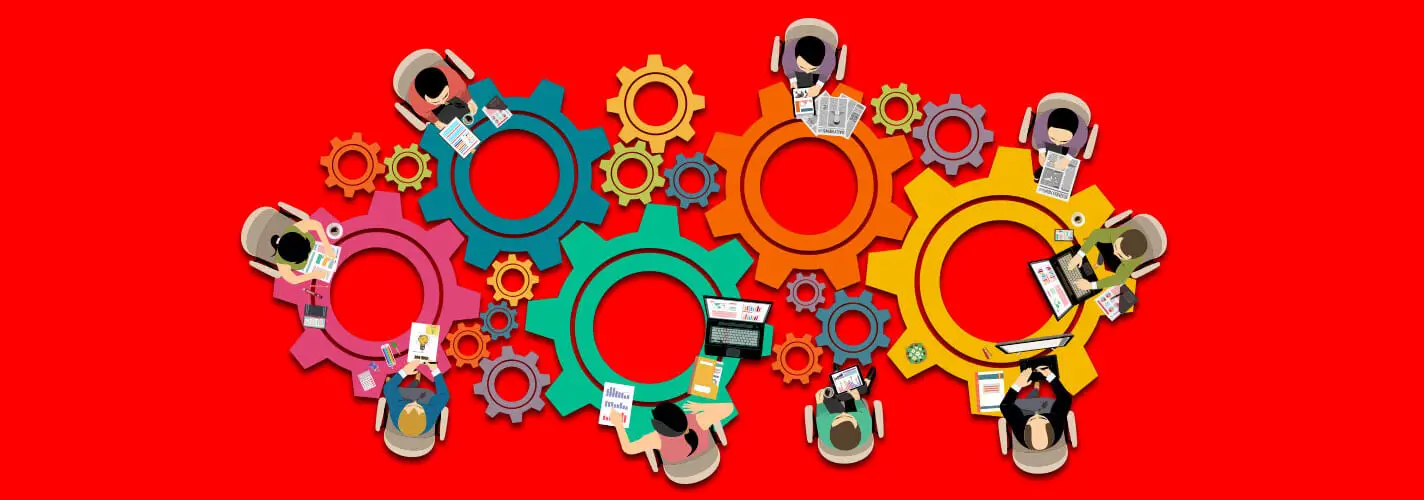
As a company you always strive for the strongest possible competitive position. And of course towards an organization that is as effective and efficient as possible. Yet we often forget to emphasize what is crucial; social capital! You can put all the bright minds together, but if they are not willing to share their knowledge and protect each other from possible risks, the team will never perform. Without confidence, knowledge, reciprocity and shared values, performance will be suboptimal.
The team and the individual are not decisive.
Research by Thomas Malone, professor at the Massachusetts Institute of Technology (MIT), shows that the intelligence of the individual within a team is absolutely not decisive for the ability to solve problems. In fact, pooling the intelligence of all team members is not enough either. Other factors play a more important role. What factors are those?
No 'cock behavior'
Just like within a football team, so-called cocky behavior can also cause problems in your team. Too many dominant people in a team disrupts the balance. In order to perform well, it is very important that everyone has time to talk, without monitoring or regulation. Especially in the case of brainstorms, it all too often happens that input is rejected by dominant people, or that the same people always speak. This hinders the results. Everyone should be able to participate without inhibitions!
Empathy works!
Empathy, what does it actually mean? By empathy, we mean the ability and skill to put yourself in someone else's shoes and understand their feelings. In other words, the capacity to empathize. Very important for a good team balance. How do you create empathy? This is best illustrated with an example. A businesswoman who had to bring together different corporate cultures following a merger had various departments within her organization draw up a budget for their own department. So far, nothing unusual. Next, they had to explain this as well as possible to colleagues from another department, who had to defend it to management. For instance, the Head of Marketing defended the needs of the technology department, the Chief Technology Officer defended the budget for customer care, and so on. The result: strong empathy between the different departments due to a better understanding of each other's interests and bottlenecks!
Gender has an influence
Everyone has a preference in terms of gender to work with. Some people really like the social nature of female employees, while others prefer the more distant approach of male employees in their team. As is often the case, and completely in line with the Dutch Polder Model, the solution lies in the middle. Gender has a major influence on the balance in your team. It is therefore advisable to have not only male team members, but also women. Women contribute greatly to empathy within a team and therefore play a very important role.
Do you want to know everything about managing a team, so that you too can get the best out of your employees? Then you have come to the right place at Kenneth Smit. Take a look at our extensive range of management training courses.
Dealing with objections
Objections are not rejections, but opportunities. When a customer raises an objection, they are indicating that they are considering your proposal. That is positive. The key is to take the objection seriously, to ask about the underlying reason, and then to respond in a targeted manner. Not by dismissing the objection, but by showing that you understand what is on the customer's mind.
An effective technique is acknowledging the objection before responding. “I understand that the investment is substantial” works better than immediately becoming defensive. By showing acknowledgment, the customer feels heard and is more open to your perspective. You can then use concrete examples and calculations to demonstrate the return on investment.
Discover how our Expert in Sales Basics training can help you put these insights into practice. For over 35 years, Kenneth Smit has been helping professionals grow.